

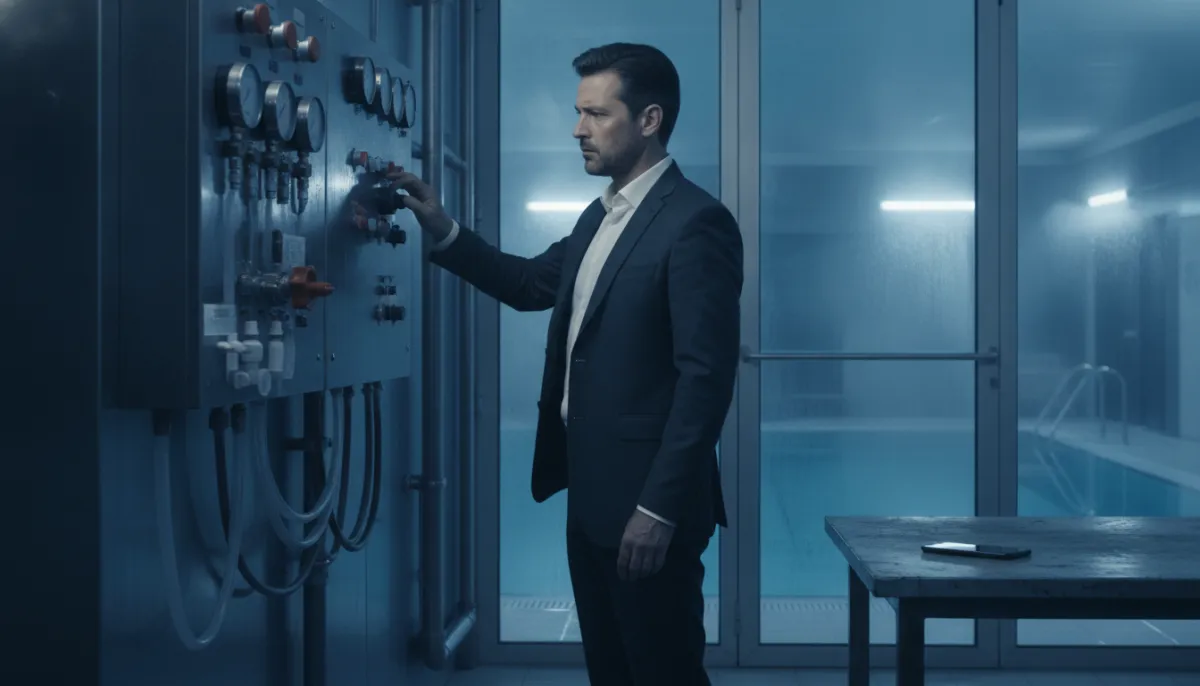
When the Microsoft 365 cloud outage hit earlier this month, most businesses experienced it as a frustrating but harmless day without email, Teams or SharePoint. At the German theme park Phantasialand in Brühl, it became a safety incident with real injuries.
According to heise online, the park's automatic chemical dosing system had added too much chlorine to a pool in the sauna area. The maintenance safety system was designed to catch exactly this: it monitors chlorine levels and sends an email alert the moment they get too high. But because of the Microsoft outage, that email never arrived. Nobody caught the problem in time, and guests kept using the area while chlorine gas built up.
The result, as reported by WinFuture and heise, was thirteen guests initially complaining of respiratory problems. That number rose to fifteen. Four people had to be taken to hospital, and one remained there for observation due to moderate injuries.
Why this matters beyond one theme park
Earlier coverage of the Microsoft 365 outage focused on lost productivity: no email, no Teams calls, no shared files for nearly a day. This incident shows a sharper edge to the same story. When a safety-critical or operationally critical alert depends on a single cloud channel, a provider outage does not just cost you time — it can remove your only warning system at the exact moment you need it most.
Phantasialand's dosing system almost certainly worked exactly as designed. The flaw was not in the chemistry or the sensors — it was in the single point of failure sitting between "problem detected" and "human notified." Email, routed through one cloud provider, was that single point. When the provider went dark, so did the warning.
Most Swiss SMEs do not run chlorine dosing systems. But plenty run equivalent single-channel alert setups without realising it: cold storage and fridge monitoring, server room temperature and water sensors, burglar and fire alarms tied to a monitoring email inbox, backup-failure notifications, UPS and power alerts, or even simple "someone unlocked the door after hours" notifications. If the only way that alert reaches a human is one email address on one cloud platform, you have the same architecture that failed at Phantasialand — just with a different payload.
What to check today
- List every automated alert your business depends on. Think beyond IT: cold chain, alarm systems, access control, server rooms, production equipment, backup jobs. For each one, ask: what happens if the notification email simply never arrives?
- Add a second, independent channel. SMS, a phone call trigger, a push notification through a different provider, or a physical on-site indicator (light, buzzer) that does not depend on any cloud service at all. If your alarm system supports it, enable a non-email escalation path now.
- Test for silent failure, not just outright failure. The dangerous scenario isn't a crashed system that obviously needs attention — it's one that looks fine while quietly not delivering anything. Send yourself a test alert today and confirm it actually arrives, rather than assuming it does.
- Set a maximum "time without confirmation" rule. If a critical system is supposed to report in every hour and hasn't, someone should be alerted through a different channel — not just wait for the next scheduled email.
- Review who gets alerted and how quickly they can act. An alert that only reaches one inbox, checked once a day, is barely better than no alert at all.
Where Flitz.ai fits in
This is exactly the kind of gap that gets missed when IT setups grow organically over years. Flitz.ai, operated by The Mejlerö Company GmbH in Engelberg, helps Swiss SMEs in Obwalden, Nidwalden, Lucerne and Zurich review network and alert setups, set up Microsoft 365 and endpoint protection properly, and build in the redundancy that keeps critical notifications working even when one cloud provider doesn't. A free network analysis and a free one-hour consultation are a practical starting point if you're not sure your own alert chain would survive the next outage.
Cloud outages and AI-driven attacks are now a near-daily feature of business IT. We'll keep tracking the incidents that matter and reporting what Swiss business owners need to do about them — this week, it's worth a few minutes checking whether your most important alarm has a backup voice.



 Switzerland.