

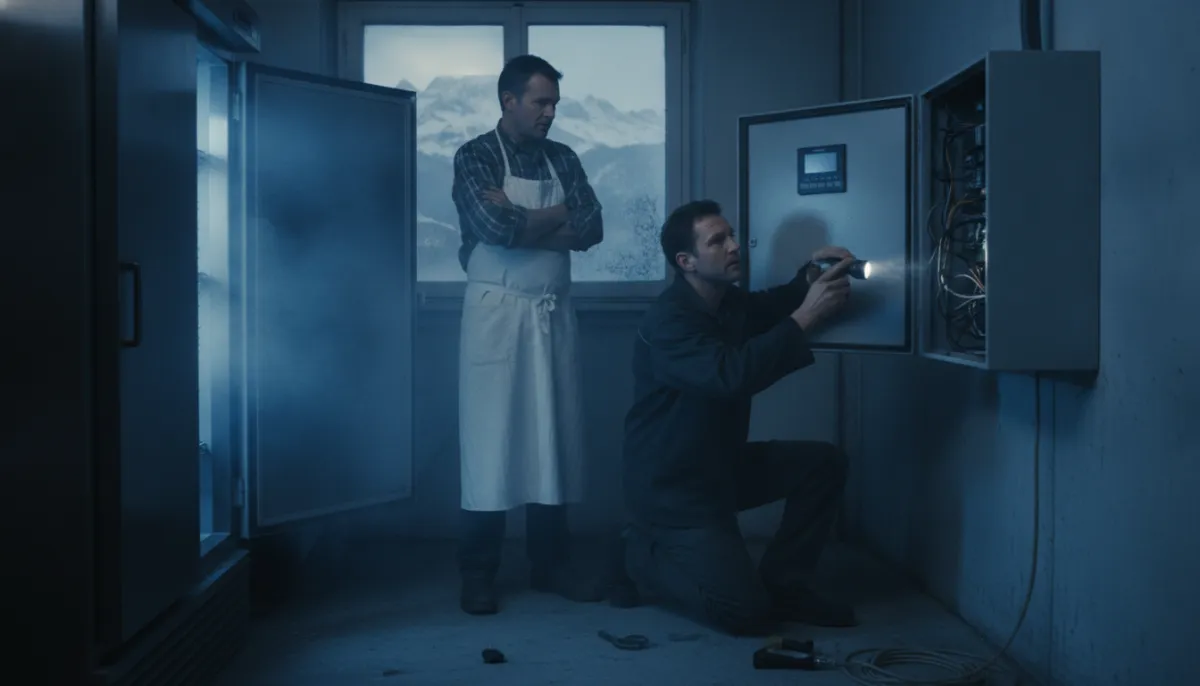
Until this week, cold-chain sabotage looked like a problem for European supermarket chains far from Switzerland. That changed when hackers manipulated the refrigeration controls at Lüthi's Fleischwaren, a butcher shop in Köniz BE, spoiling meat and forcing a temporary closure. Three Volg stores reported similar incidents, with attackers altering settings on their refrigeration units. This is no longer a theoretical risk for Swiss SMEs — it is already happening on Swiss soil.
The scale of what's behind these attacks is also becoming clearer. In Germany, the domestic intelligence service (BfV), the foreign intelligence service (BND) and the military intelligence service (MAD) have all joined police investigations into a wave of refrigeration sabotage across Europe. The case is now being handled by Germany's joint hybrid-threats center (GAZ Hybrid), where these agencies cooperate. When intelligence services get involved, it signals that this is viewed as more than ordinary cybercrime.
On November 5, 2026, US agencies CISA, the FBI, HHS, USDA and DOT issued a joint fact sheet warning that malicious actors are actively targeting industrial refrigeration and cold-chain monitoring systems worldwide. CISA's Chris Butera put it plainly: every organization that relies on refrigeration and monitoring systems should assume it could be a target, and should act now to close known security gaps.
Why Swiss SMEs are exposed
The common thread in these attacks is poorly secured remote-maintenance access — the same kind of equipment used by countless Swiss retailers, butchers, restaurants, bakeries and logistics firms to let technicians check and adjust refrigeration systems from outside the building. If that access point is weak or exposed to the open internet, it becomes an open door, regardless of how small the business is.
This isn't an isolated spike either. Switzerland's Federal Office for Cybersecurity (BACS) recorded 389 reported incidents against critical infrastructure operators between January and October 2026 — already far above the 222 incidents recorded for all of 2025. Attacks on operational technology (OT), the systems that control physical equipment like fridges, HVAC and production lines, are rising fast, and attackers increasingly see smaller businesses as easier entry points than well-defended large enterprises.
What to check this week
- Find every piece of internet-connected equipment. Refrigeration units, HVAC systems, alarm panels and any device with remote-maintenance access should be listed and reviewed. If you don't know it's connected, you can't secure it.
- Remove public internet exposure where possible. Remote-maintenance access should go through a secured VPN or similarly protected channel, never a direct, unrestricted connection to the open internet.
- Change default and shared credentials. Many OT and refrigeration systems still run on factory-default passwords or logins shared across multiple technicians. Replace them with unique, strong credentials, and enable two-factor authentication wherever supported.
- Apply firmware and software updates. Refrigeration controllers and monitoring systems are often forgotten in regular patch cycles. Check with your equipment vendor or maintenance provider for outstanding updates.
- Monitor logs and set alerts. If your refrigeration or monitoring system can log access and parameter changes, make sure someone is actually watching those logs — or set up alerts for unusual changes.
- Talk to your maintenance contractor. Ask explicitly how they access your systems remotely and whether that access is secured. Many of these attacks exploit the maintenance vendor's access, not a direct weakness in your own network.
None of these steps require a large budget, but they do require someone to actually go through your connected equipment and remote-access points — something that's easy to postpone until it's too late.
Flitz.ai keeps watching this space
This is exactly the kind of threat that moves fast and gets overlooked by businesses focused on daily operations rather than IT security. Flitz.ai, powered by The Mejlerö Company GmbH, provides practical IT support for SMEs in Obwalden, Nidwalden, Lucerne and Zurich — including network security basics, remote-access reviews and endpoint protection. If you're unsure whether your refrigeration, alarm or other connected equipment is exposed, a free network analysis is a straightforward way to find out. We'll keep tracking stories like this one and reporting what Swiss business owners need to do next.


 Switzerland.